
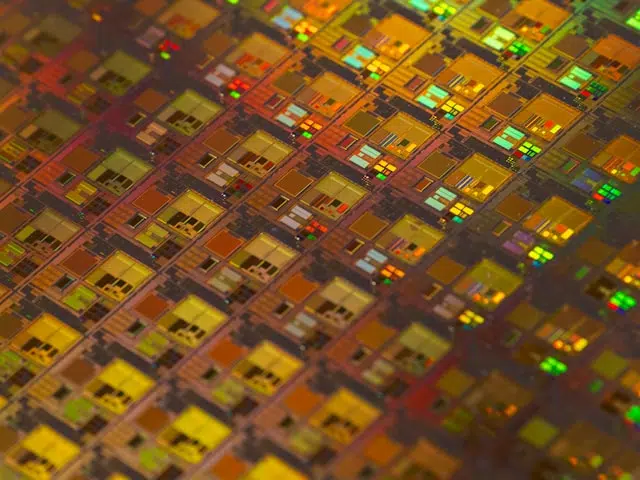
Semiconductors remain the backbone of the digital economy, powering everything from artificial intelligence and cloud computing to smartphones and electric vehicles. As global data consumption accelerates and AI workloads grow more complex, demand for high-performance chips and storage solutions continues to rise. Unsurprisingly, the semiconductor sector has delivered outsized returns, outperforming the broader market by a wide margin over the past year.
However, not all chipmakers are positioned equally for the next phase of innovation. Some companies enjoy structural advantages that allow them to compound growth, while others are losing relevance as technology cycles shift. Below, we highlight two semiconductor stocks with strong competitive advantages—and one semiconductor stock we believe investors should avoid as the industry evolves.
Semiconductor Stock We Avoid: Skyworks Solutions (SWKS)
Market Capitalization: ~$8.7 billion
Skyworks Solutions designs radio-frequency (RF) chips used primarily in smartphones, autos, and industrial wireless applications. While the company once benefited from smartphone upgrade cycles, its dependence on mobile devices has become a growing weakness.
Why Skyworks Falls Behind
Despite the broader semiconductor boom, Skyworks has struggled to maintain momentum:
- Revenue contraction: Sales have declined at an average rate of 7.5% annually over the past two years, signaling shrinking demand.
- Weak forward outlook: Consensus estimates point to another double-digit revenue decline over the next 12 months.
- Margin erosion: Operating margins have compressed sharply, falling nearly 20 percentage points over five years, as costs rose faster than revenue.
- Limited exposure to AI: Unlike peers tied to data centers or AI infrastructure, Skyworks remains heavily tethered to mature smartphone markets.
While the stock trades at a seemingly modest valuation, cheap does not always mean compelling. Without a clear catalyst tied to next-generation computing or AI, Skyworks appears structurally disadvantaged in the current semiconductor cycle.
Semiconductor Stock to Watch: Seagate Technology (STX)
Market Capitalization: ~$70 billion
Seagate Technology is a global leader in data storage solutions, producing hard disk drives (HDDs) and solid-state storage used across PCs, cloud platforms, and AI data centers. As AI models expand, so does the need for high-capacity, cost-efficient storage—a tailwind for Seagate.
Why Seagate Has a Competitive Edge
Seagate’s positioning looks increasingly attractive:
- Strong growth trajectory: Revenue has grown at an impressive 18.5% annualized rate over the past two years, driven by cloud and enterprise demand.
- AI-driven storage demand: Training and deploying AI models requires massive datasets, favoring Seagate’s high-capacity storage solutions.
- Margin expansion: Operating margins have improved by nearly 7 percentage points over five years, reflecting better cost discipline.
- Scale advantage: Few competitors can match Seagate’s manufacturing scale and long-term relationships with hyperscalers.
While Seagate is not a pure AI chip play, it benefits indirectly from every dollar spent on AI infrastructure, making it a compelling second-derivative investment in the AI boom.
Semiconductor Stock With a Moat: Universal Display (OLED)
Market Capitalization: ~$5.7 billion
Universal Display operates in a niche—but highly profitable—corner of the semiconductor ecosystem. The company licenses proprietary OLED materials and intellectual property used in premium displays for smartphones, TVs, wearables, and automotive screens.
Why Universal Display Stands Out
Universal Display offers a rare blend of growth, margins, and defensibility:
- Consistent revenue growth: Sales have increased at a 10.5% annual rate over the past five years, outperforming much of the sector.
- Exceptional margins: Gross margins exceed 75%, reflecting its IP-driven business model.
- High operating leverage: Operating margins near 38% highlight strong scalability.
- Hard-to-replicate technology: OLED materials and patents create a durable moat that competitors struggle to breach.
As demand for premium displays expands across consumer electronics and automotive applications, Universal Display remains well-positioned to benefit from long-term adoption trends.
How These Picks Fit the Semiconductor Supercycle
The semiconductor industry is no longer just about CPUs and GPUs. Data storage, display technology, and infrastructure enablers are becoming equally critical as AI workloads grow more data-intensive and visual computing expands.
- Companies like Seagate benefit from the explosion in data creation.
- Firms like Universal Display monetize innovation through IP rather than capital-heavy manufacturing.
- Meanwhile, companies overly reliant on mature smartphone cycles, like Skyworks, face structural headwinds.
This divergence underscores why stock selection matters more than ever in the semiconductor space.
Conclusion
The semiconductor boom is real—but it’s not evenly distributed. Investors should focus on companies with durable competitive advantages, exposure to long-term technology trends, and business models that scale efficiently. Based on fundamentals, Seagate Technology and Universal Display stand out as strong candidates for continued gains, while Skyworks Solutions appears ill-positioned for the next wave of innovation.
As AI, cloud computing, and advanced electronics reshape global demand, owning the right semiconductor stocks could make all the difference in long-term portfolio performance.