
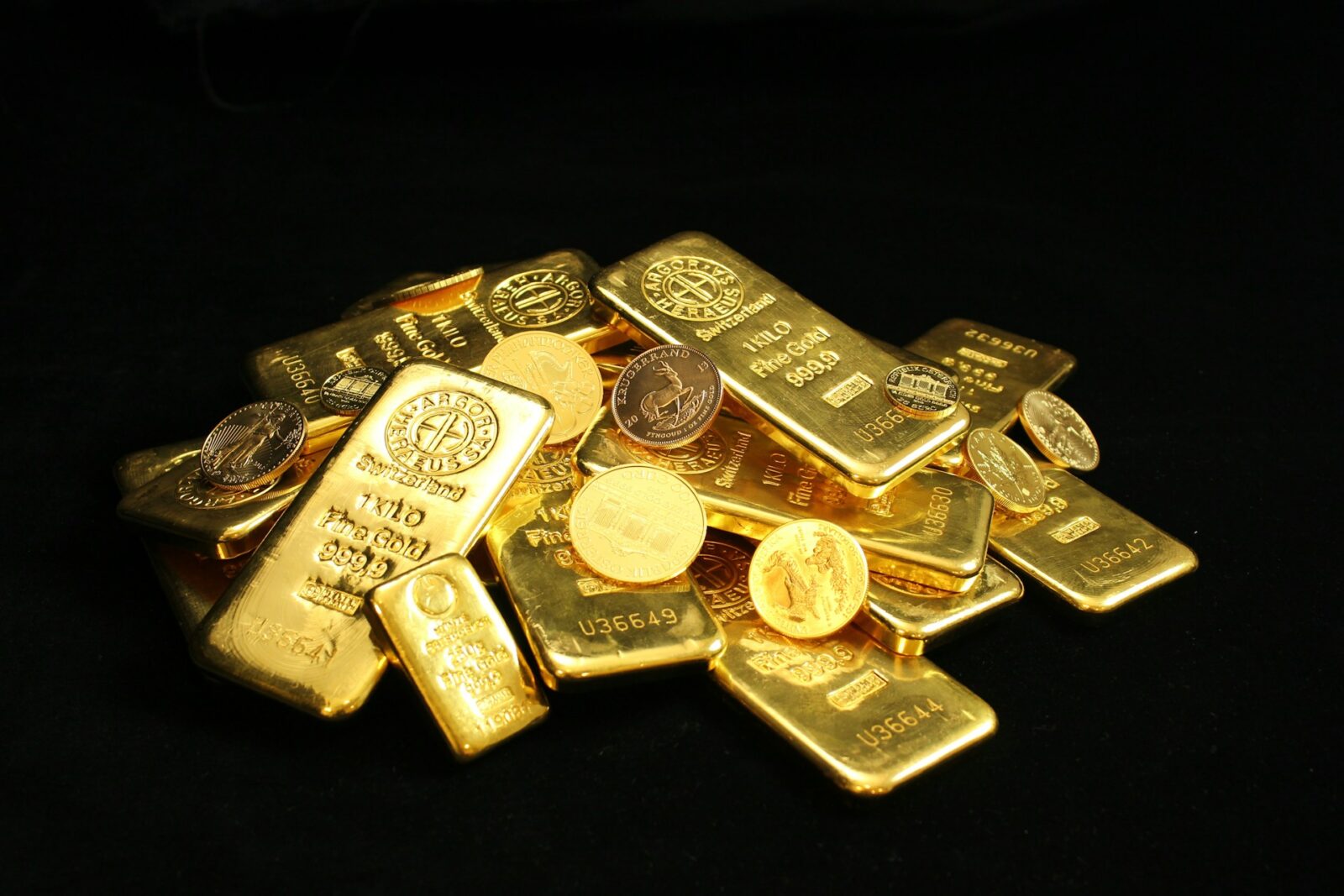
Gold prices are holding firm near record levels as investors reassess risk across global markets and shift their attention to upcoming U.S. labor data. With stretched valuations in technology stocks, persistent geopolitical uncertainty, and growing expectations of lower interest rates, bullion continues to attract demand as both a hedge and a strategic long-term asset. The current pause in prices reflects caution rather than weakness, as the gold price outlook remains closely tied to Federal Reserve policy and macroeconomic signals.
Gold Steadies After Volatile Risk-Off Moves
Bullion traded largely unchanged during U.S. hours after briefly rising earlier in the session. The stability follows a volatile end to last week, when gold and silver abruptly pulled back from intraday highs amid a broader risk-off move. That selloff was driven largely by profit-taking in high-flying artificial intelligence and technology stocks, prompting traders to rebalance portfolios.
Although gold is traditionally viewed as a hedge against equity market downturns, its short-term correlation with stocks has increased in recent months. Even so, longer-term investor behavior suggests bullion continues to serve as a portfolio stabilizer during periods of uncertainty.
Jobs Data and Rate Expectations in Sharp Focus
Market participants are now looking ahead to key U.S. economic indicators, particularly non-farm payrolls. A weaker-than-expected jobs report would strengthen the case for further Federal Reserve rate cuts in 2026, a scenario that typically supports gold prices. Lower interest rates reduce the opportunity cost of holding non-yielding assets like gold, making bullion more attractive relative to bonds and cash.
Recent commentary from policymakers has added to the uncertainty. President Donald Trump reiterated his preference for aggressively lower interest rates and suggested the next Federal Reserve chair would work closely with the White House on monetary policy. Such remarks have fueled speculation that the central bank could adopt a more dovish stance next year.
A Historic Year for Precious Metals
Gold has surged more than 60% this year, while silver has gained over 100%, putting both metals on track for their strongest annual performances since the late 1970s. Investor demand has been broad-based, spanning central banks, institutional investors, and retail buyers.
According to the World Gold Council, holdings in gold-backed exchange-traded funds have increased in every month this year except one, highlighting consistent inflows even during periods of price consolidation. This steady accumulation underscores confidence in gold’s long-term role as a store of value.
Central Banks Remain a Powerful Tailwind
Central-bank buying continues to be one of the most important structural drivers of the gold market. Major financial institutions expect this trend to persist for years. Analysts at Goldman Sachs project that ongoing central-bank purchases, combined with renewed private investment under a Fed easing cycle, could push gold prices toward $4,900 by the end of 2026.
Goldman’s outlook assumes average monthly central-bank purchases of roughly 70 tons next year, reinforcing the idea that official-sector demand is no longer cyclical, but structural.
Mixed Forecasts, Strong Underlying Support
Not all forecasts point to a straight-line rally. Analysts at ANZ expect gold to experience a “year of two halves” in 2026, potentially peaking near $4,800 in the first half before retreating modestly later in the year. Even so, they emphasize that resilient investment flows and sustained central-bank demand should keep prices historically elevated.
In other words, pullbacks may occur, but the underlying support for gold remains firmly intact.
Silver and Other Metals Add to the Bullish Picture
Silver has also played a key role in the precious metals rally, supported by lingering supply tightness following a historic market squeeze earlier this year. The metal recently touched fresh records and continues to benefit from strong industrial demand and uncertainty surrounding U.S. trade and import policies.
The U.S. Geological Survey’s decision to add silver to its list of critical minerals has further complicated supply dynamics. While analysts expect silver to ultimately be excluded from tariffs, uncertainty alone has encouraged traders to keep metal onshore, tightening global availability.
Platinum and palladium have joined the rally as well, with platinum reaching its highest level in more than a decade, reflecting renewed interest across the broader commodities complex.
Gold’s ability to trade steadily near record highs reflects a market balancing short-term caution with strong long-term conviction. As investors await crucial U.S. jobs data and clearer signals on interest rates, bullion remains well-supported by central-bank buying, ETF inflows, and persistent macro uncertainty. While volatility may resurface, the broader gold price outlook continues to favor strength, positioning the metal as a core defensive asset heading into 2026.